Association Between Parity, Maternal Age, and Chronic Energy Deficiency (CED) Among Pregnant Women at Bontonompo II Community Health Center, Gowa Regency
DOI:
https://doi.org/10.69632/jgkk.v4i01.105Keywords:
Chronic Energy Deficiency, Maternal , Nutritional Status, Parity, PregnancyAbstract
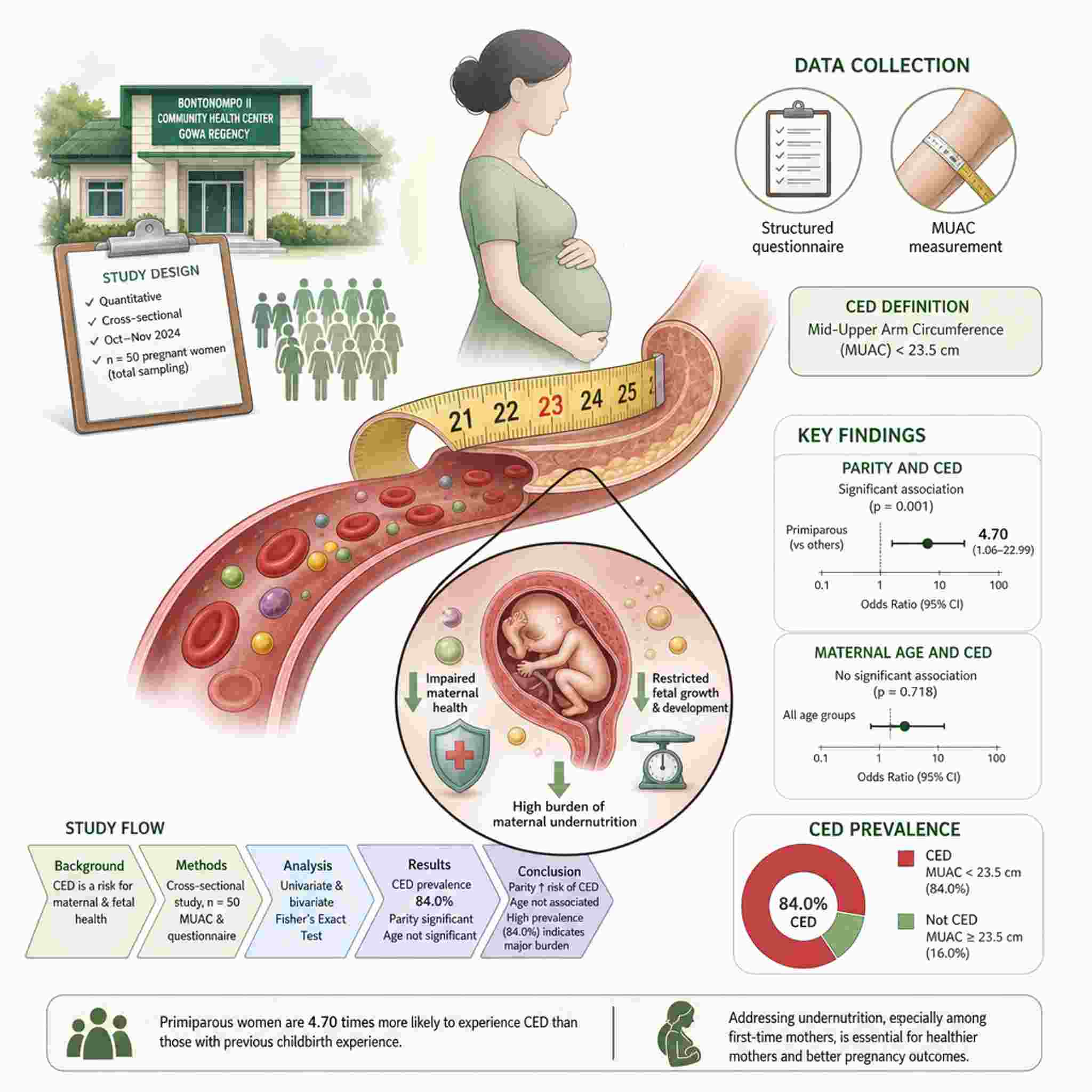
Background: Chronic Energy Deficiency (CED) may adversely affect maternal health as well as fetal growth and development and is commonly identified using a Mid-Upper Arm Circumference (MUAC) value of less than 23.5 cm. Objective: This study aimed to analyze the association between maternal parity and age with the incidence of Chronic Energy Deficiency (CED) among pregnant women. Methods: A quantitative study with a cross-sectional design was conducted from October to November 2024. The study involved 50 pregnant women selected using a total sampling technique. Data were collected using structured questionnaires and MUAC measurements. Data were analyzed using univariate and bivariate analyses, with Fisher’s Exact Test used to assess the association between maternal age, parity, and CED. Results: Among the respondents, 84.0% were classified as having CED. Fisher’s Exact Test revealed a significant association between parity and CED incidence (p = 0.001). Odds ratio analysis showed that primiparous women had 4.70 times greater odds of experiencing CED than multiparous and grandemultiparous women (OR = 4.70; 95% CI: 1.06–22.99). In contrast, maternal age was not significantly associated with CED incidence (p = 0.718). Supplementary interview findings suggested that some primiparous women experienced challenges related to pregnancy symptoms and nutritional management; however, these observations were not included in the statistical analysis. Conclusions: Maternal parity was significantly associated with Chronic Energy Deficiency (CED) among pregnant women, with primiparous women being more vulnerable to CED than women with previous childbirth experience. In contrast, maternal age was not significantly associated with CED incidence. The prevalence of CED among pregnant women in the study area was high (84.0%), indicating a substantial burden of maternal undernutrition.
Downloads
Published
How to Cite
Issue
Section
License
Copyright (c) 2026 Liska Alfaaizin, Nur Adnin, Rina Silvana Jamal, Nurbaya Nurbaya

This work is licensed under a Creative Commons Attribution-NonCommercial-ShareAlike 4.0 International License.