Nutritional Quality and Food Safety Evaluation of Dangke: The Role of Coagulants and Production Hygiene Practices
DOI:
https://doi.org/10.69632/jgkk.v4i01.111Keywords:
Coagulant, Dangke, Local Food, Nutritional Safety, QualityAbstract
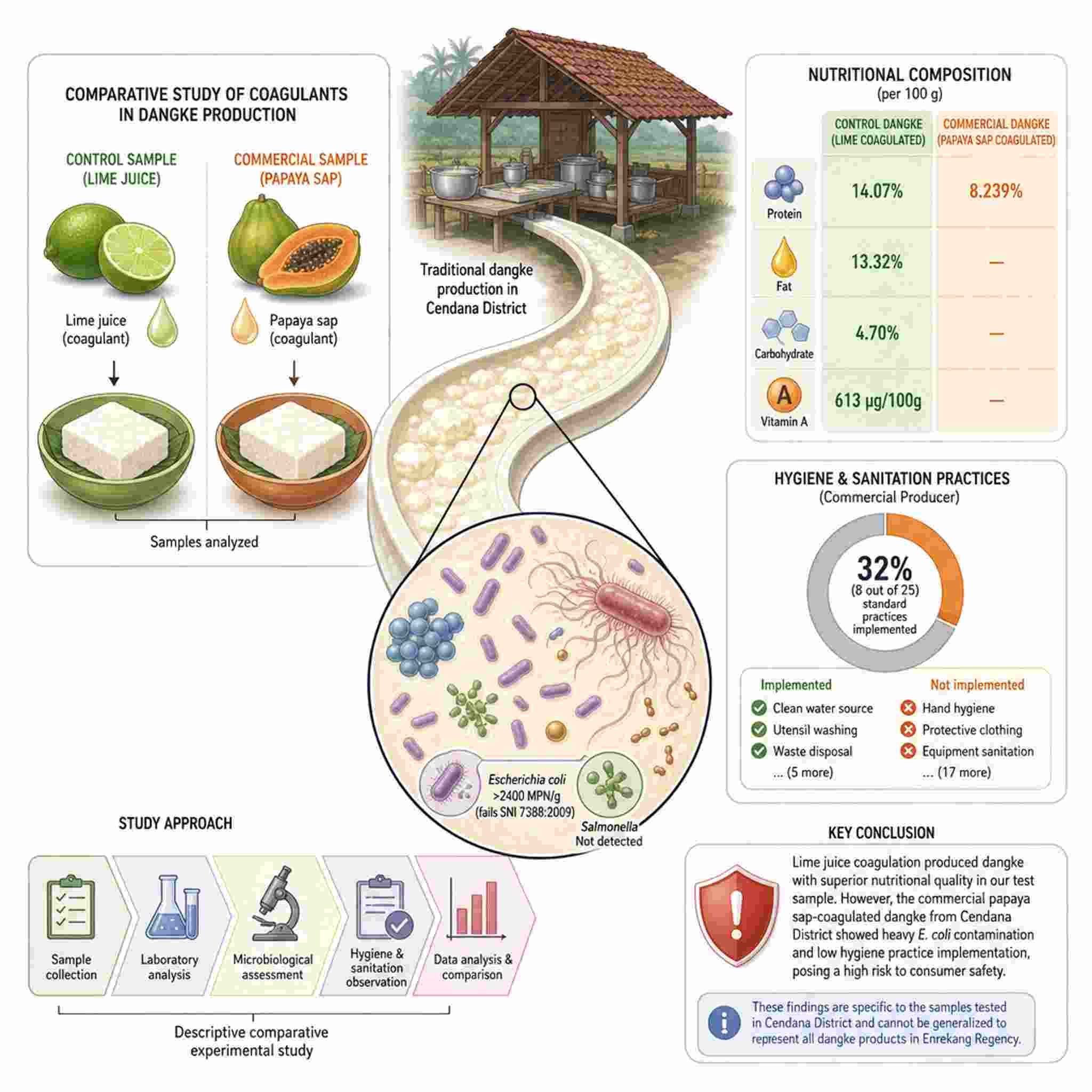
Background: Traditional dangke production in Cendana District lacks optimal hygiene and sanitation practices, creating a potential risk for microbial contamination. This study aimed to evaluate the nutritional content, microbiological safety, and hygiene and sanitation practices associated with dangke production in Cendana District. Method: The study analyzed a control dangke sample (produced by the researchers using lime juice as a coagulant) alongside a commercial dangke sample (produced by a local maker using papaya sap as a coagulant). This comparative experimental study, employing a descriptive approach, utilized a single sample for each type of coagulant. Result: Laboratory analysis revealed that the control dangke (lime-coagulated) possessed a denser nutritional profile, containing 14.07% protein, 13.32% fat, 4.70% carbohydrates, and 613 µg/100g of vitamin A. In contrast, the commercial dangke (papaya sap-coagulated) exhibited lower protein content (8.239%) and showed heavy contamination with Escherichia coli (>2400 MPN/g, failing to meet SNI 7388:2009 standards), although it tested negative for Salmonella. Sanitation observations indicated that the producer implemented only 32% (8 out of 25) of the standard hygiene and sanitation practices. Conclusion: While lime juice coagulation yielded optimal nutritional composition in the researchers' test samples, the commercial papaya sap-coagulated dangke from Cendana District posed a high risk regarding microbiological safety. These findings are specific to the samples tested in Cendana District and cannot be generalized to represent all dangke products in Enrekang Regency.
Downloads
Published
How to Cite
Issue
Section
License
Copyright (c) 2026 feni andini, Fitriani Umar, Sukmawati Thasim, Rasidah Wahyuni Sari

This work is licensed under a Creative Commons Attribution-NonCommercial-ShareAlike 4.0 International License.