The Impact of Online Nutritional Education Via The Bushagita Digital Handbook on Mothers' Knowledge and Attitudes Toward Halal and Toddler Nutrition
DOI:
https://doi.org/10.69632/jgkk.v3i2.76Keywords:
Digital handbook, Halal nutrition, Maternal knowledge, Online education, ToddlersAbstract
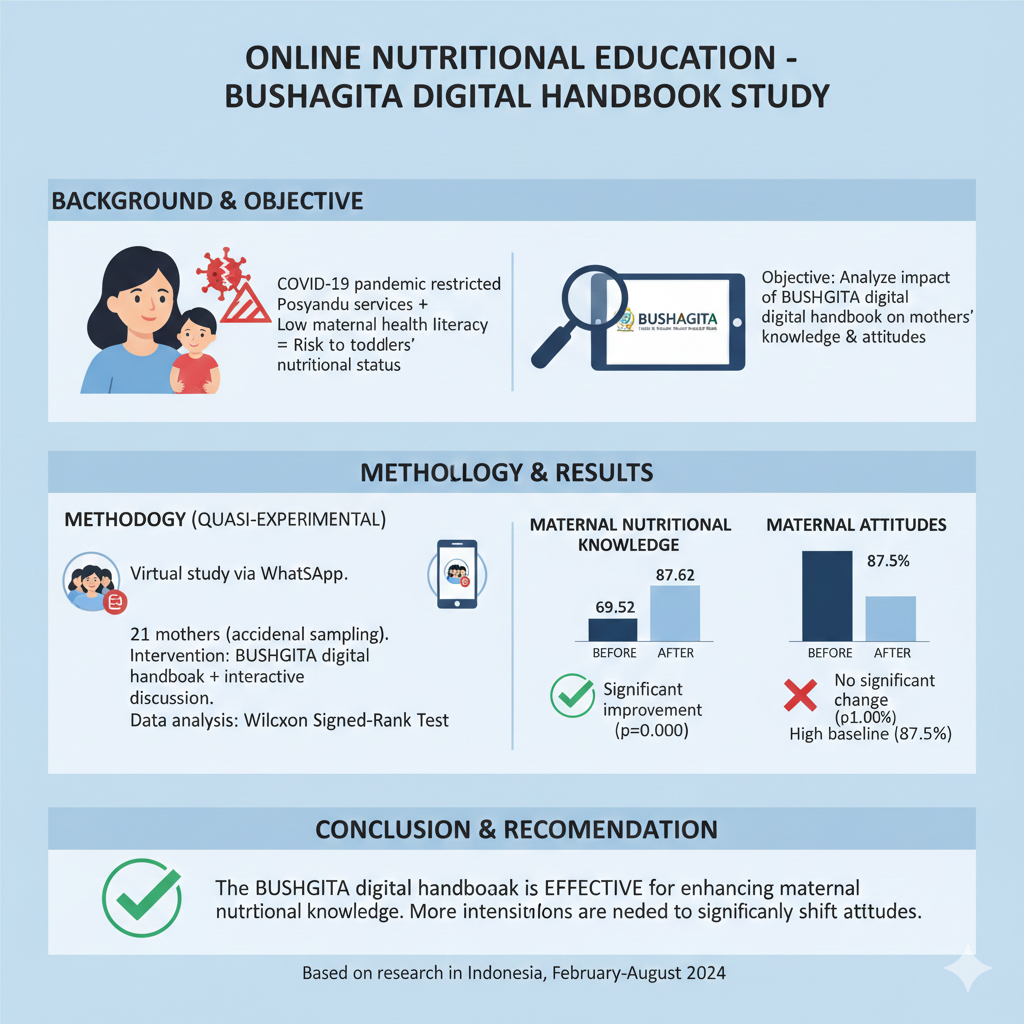
Background: The COVID-19 pandemic has restricted social mobility, affecting community health services like Posyandu. This situation, combined with low maternal health literacy, poses a risk to toddlers' nutritional status. Objective: This study aims to analyze the impact of online nutritional education using the BUSHAGITA (Buku Saku Halal dan Gizi Balita) digital handbook on mothers' knowledge and attitudes. Methods: A quasi-experimental study with a one-group pre-posttest design was conducted virtually via WhatsApp. Twenty-one mothers of toddlers were selected through accidental sampling. The intervention consisted of distributing the BUSHAGITA digital handbook followed by interactive discussions. Data were analyzed using the Wilcoxon Signed-Rank Test. Results: Maternal nutritional knowledge significantly improved after the intervention (p=0.000), with the mean score increasing from 69.52±13.95 to 87.6211.79. However, there was no significant change in maternal attitudes (p=1.000), although the baseline for positive attitudes was already high (87.5%). Conclusion: The BUSHAGITA digital handbook is an effective medium for enhancing maternal nutritional knowledge in a digital setting, although more intensive interventions are needed to significantly shift attitudes.
Downloads
Published
How to Cite
Issue
Section
License
Copyright (c) 2026 Zakia Umami, Amalina Ratih Puspa, Lusi Anindia Rahmawati, Shindy Aulia Sarwendah, Salsa Billa, Andi Muh Asrul Irawan

This work is licensed under a Creative Commons Attribution-NonCommercial-ShareAlike 4.0 International License.