Nutritional Content and Organoleptic Acceptance of Dangke and Pumpkin-Based Chips as a Snack for School-Age Children
DOI:
https://doi.org/10.69632/jgkk.v4i01.112Keywords:
Chips, Dangke, Pumpkin , School age children, SnackAbstract
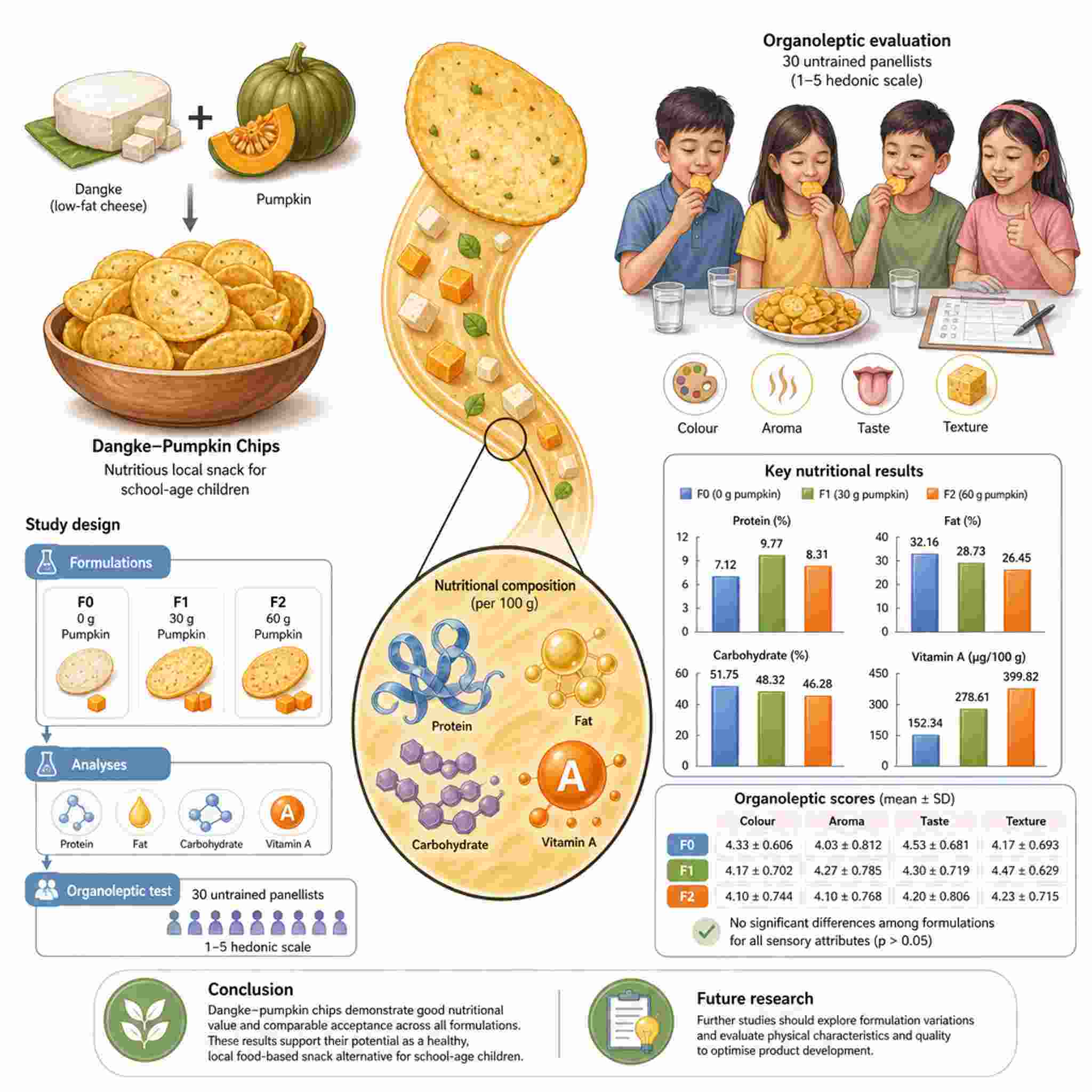
Background: School-age children require balanced nutrition to support growth and development; however, the consumption of low-nutrient snacks remains a concern. This study aimed to analyse the nutritional content and acceptance levels of chips made from a combination of dangke and pumpkin as a healthy, local food-based snack alternative for school-age children. Method: The study employed a laboratory experiment with a quantitative approach. The study tested three formulations: F0 (0 g pumpkin), F1 (30 g pumpkin), and F2 (60 g pumpkin). Nutritional analysis covered protein, fat, carbohydrate, and vitamin A content, while organoleptic testing involved 30 untrained panellists using a 1–5 hedonic scale. Results: The results showed that F0 had the highest fat (32.16%) and carbohydrate (51.75%) content, F1 had the highest protein content (9.77%), and F2 had the highest vitamin A content (399.82 µg/100 g). In the organoleptic test, F0 received the highest scores for colour (4.33 ± 0.606) and taste (4.53 ± 0.681), while F1 received the highest scores for aroma (4.27 ± 0.785) and texture (4.47 ± 0.629). Statistical analysis indicated no significant differences (p>0.05) in colour, aroma, taste, or texture among formulations F0, F1, and F2. Thus, the three formulations did not differ significantly in terms of panellist acceptance, despite descriptive differences in mean values. Conclusion: This study demonstrates that chips combining dangke and pumpkin have the potential to be developed as a local food-based snack alternative with favourable nutritional content and acceptance levels. Future research is recommended to develop formulation variations and conduct testing on the product's physical characteristics and quality.
Downloads
Published
How to Cite
Issue
Section
License
Copyright (c) 2026 Rafikaazhari Juhari

This work is licensed under a Creative Commons Attribution-NonCommercial-ShareAlike 4.0 International License.