The Relationship Between Energy Intake from the Free Nutritious Meal (MBG) Program and Energy Adequacy Levels Among Adolescents at MAN 2 Parepare City
DOI:
https://doi.org/10.69632/jgkk.v4i01.113Keywords:
Adolescents, Energy Intake, Energy Adequacy, Nutritional Status, MBGAbstract
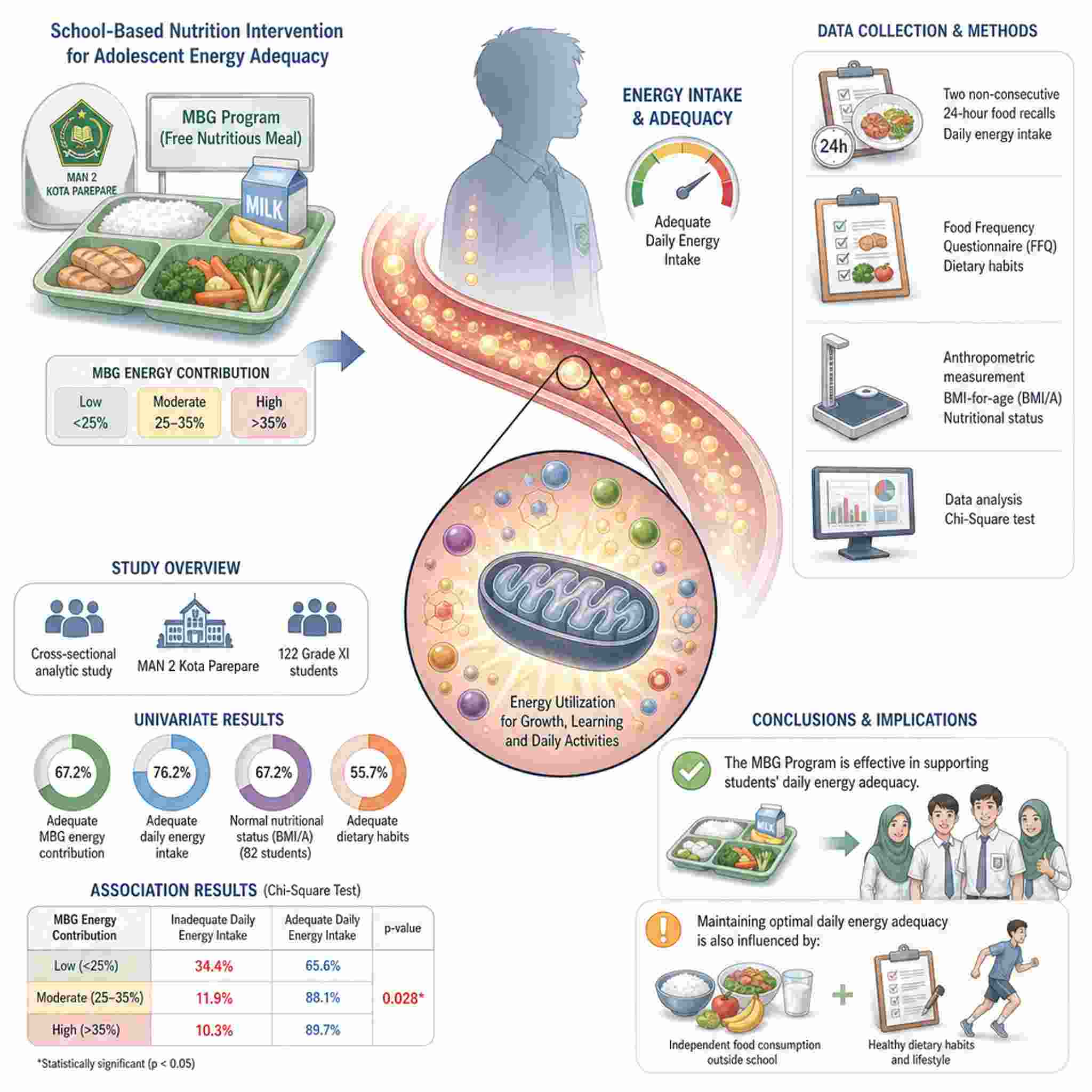
Background: The MBG is a school-based nutrition intervention designed to help meet students' energy requirements. This study aimed to analyze the contribution of energy intake from the MBG Program to the level of daily energy adequacy among students at MAN 2 Kota Parepare, while considering students' dietary habits. Methods: This study used an observational analytic design with a cross-sectional approach involving 122 eleventh-grade students at MAN 2 Kota Parepare, selected using the Slovin formula. Data were collected using questionnaires, two non-consecutive 24-hour food recalls to assess daily energy intake, a Food Frequency Questionnaire (FFQ) to describe dietary habits, and anthropometric measurements using BMI-for-age (BMI/A) to determine nutritional status. Data were analyzed using the Chi-Square test to examine associations between variables. Results: The univariate analysis showed that most students had energy intake from the MBG Program in the adequate category (67.2%), adequate daily energy intake (76.2%), normal nutritional status (67.2%, 82 students), and dietary habits in the adequate category (55.7%). The Chi-Square test showed a statistically significant association between the contribution of energy intake from the MBG Program and students' daily energy adequacy (p = 0.028). Specifically, 34.4% of students with a low MBG energy contribution (<25%) had inadequate daily energy intake, whereas 88.1% of students with a moderate MBG energy contribution (25–35%) achieved adequate daily energy intake. Conclusion: The MBG Program was shown to be an effective school-based nutrition intervention in supporting students' daily energy adequacy. However, maintaining optimal daily energy adequacy is also influenced by independent food consumption patterns and dietary habits outside school.
Downloads
Published
How to Cite
Issue
Section
License
Copyright (c) 2026 Hasnaeni Hasnaeni, Haniarti Haniarti, Nurlinda Nurlinda , Rini Anggraeny

This work is licensed under a Creative Commons Attribution-NonCommercial-ShareAlike 4.0 International License.