Digital Food Delivery and Ultra-Processed Food Consumption: Assessing the Nutritional Profile of University Students in Parepare City
DOI:
https://doi.org/10.69632/jgkk.v4i01.114Keywords:
Adolescents, Energy Intake, Energy Adequacy, MBG, Nutritional StatusAbstract
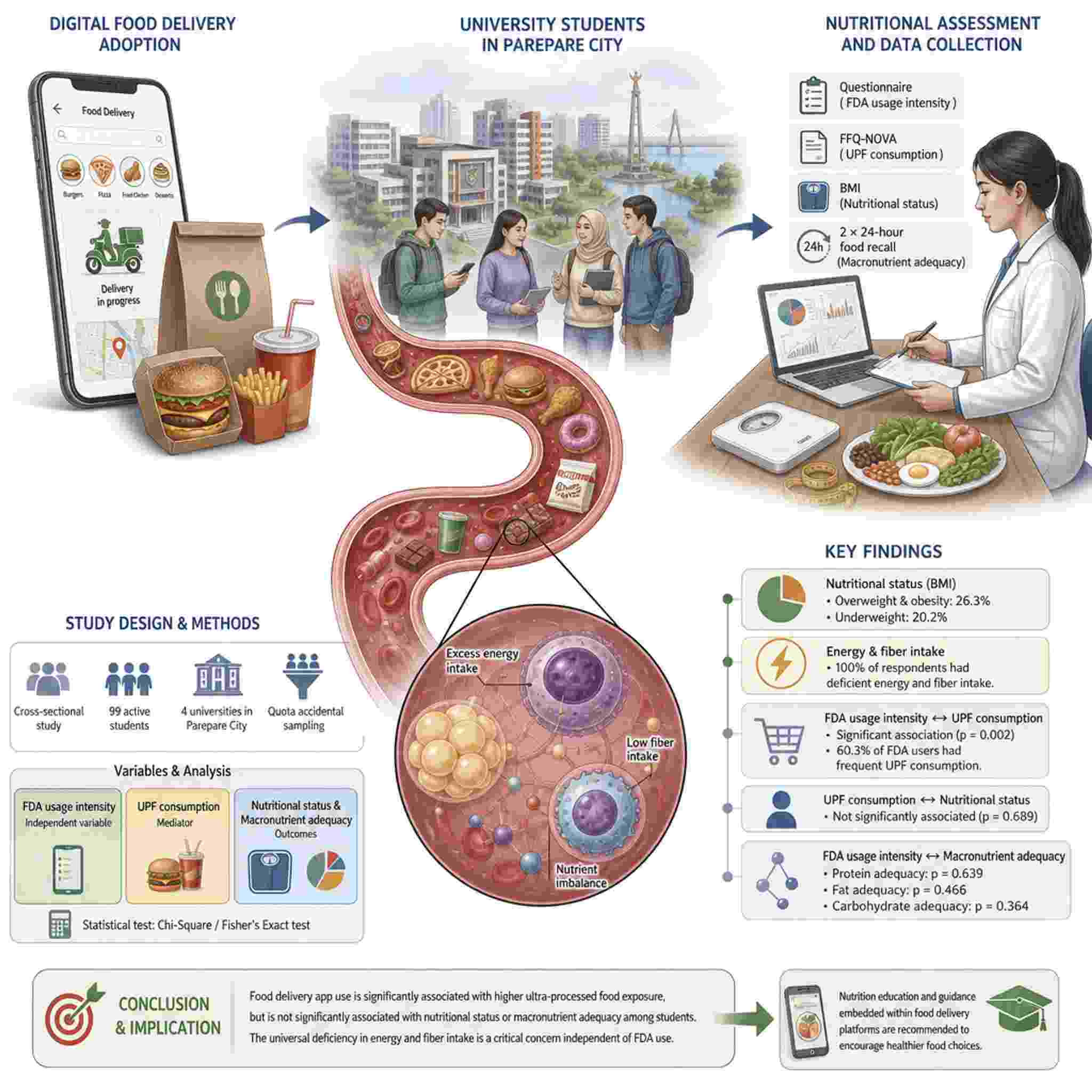
Background: Ultra-processed food (UPF) consumption among university students has risen alongside the widespread adoption of food delivery apps (FDA), yet its link to nutritional status remains inconsistent. Objective: This study aimed to assess the association between FDA usage intensity, UPF consumption, and nutritional status among university students in Parepare City. Methods: A cross-sectional study was conducted among 99 active students from four universities in Parepare City, selected through quota accidental sampling. FDA usage intensity and UPF consumption were assessed using a questionnaire and the FFQ-NOVA, nutritional status was determined from body mass index (BMI), and macronutrient adequacy was measured using a 2×24-hour food recall. Variables were analyzed using the Chi-Square/Fisher's Exact test. Results: Overweight and obesity together affected 26.3% of respondents, while underweight affected 20.2%; notably, all respondents (100%) had deficient energy and fiber intake. FDA usage intensity was significantly associated with UPF consumption (p=0.002), with 60.3% of FDA users falling into the frequent UPF consumption category. UPF consumption was not significantly associated with nutritional status (p=0.689), nor was FDA usage intensity associated with the adequacy of protein (p=0.639), fat (p=0.466), or carbohydrate (p=0.364) intake. Conclusion: FDA use is significantly associated with higher UPF exposure but is not significantly associated with nutritional status or macronutrient adequacy among students. The universal deficiency in energy and fiber intake highlights a critical nutritional concern independent of FDA use. Nutrition education, including guidance embedded within food delivery platforms, is recommended to encourage healthier food choices.
Downloads
Published
How to Cite
Issue
Section
License
Copyright (c) 2026 Ade Triardana Damas Fardillah Mustari, Haniarti Haniarti, Fitriani Umar, Makhrajani Majid

This work is licensed under a Creative Commons Attribution-NonCommercial-ShareAlike 4.0 International License.